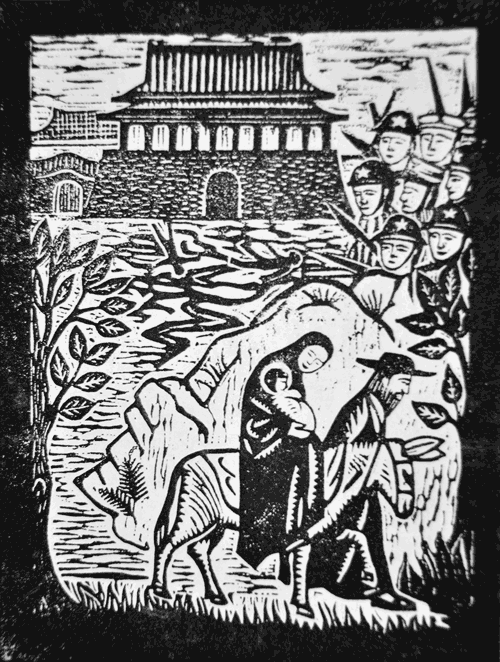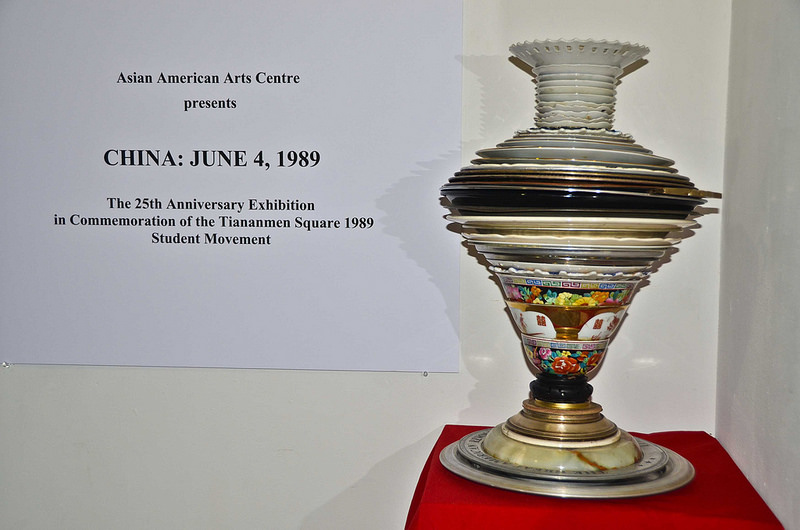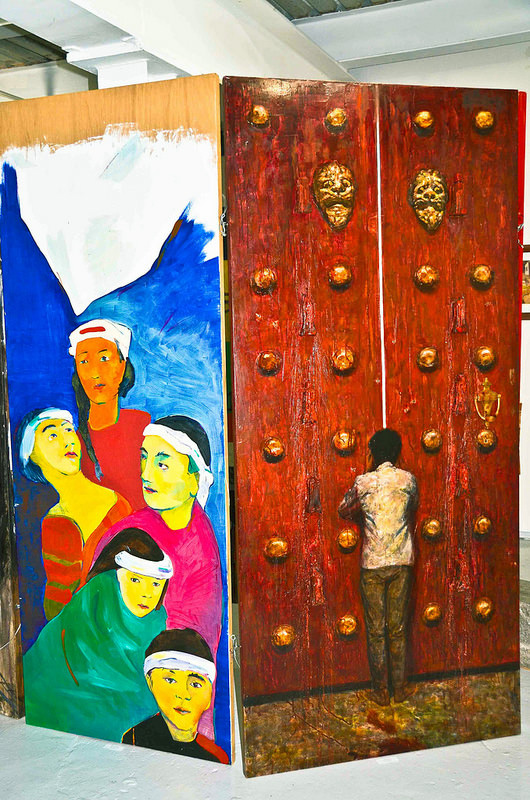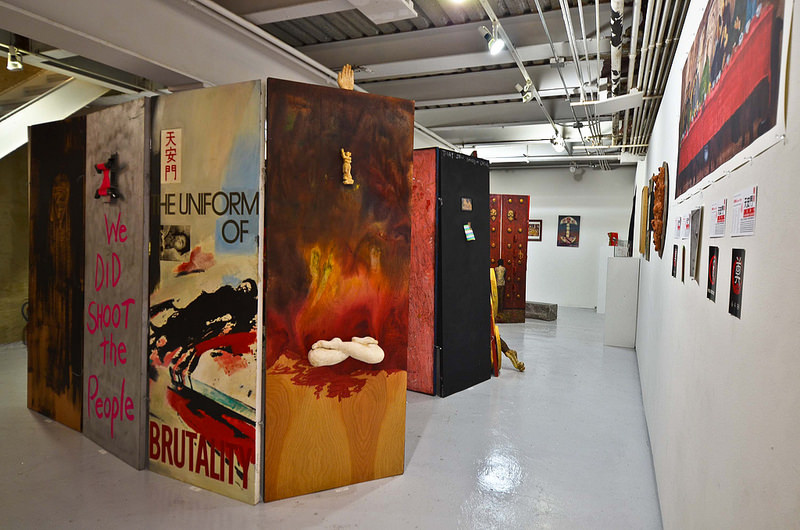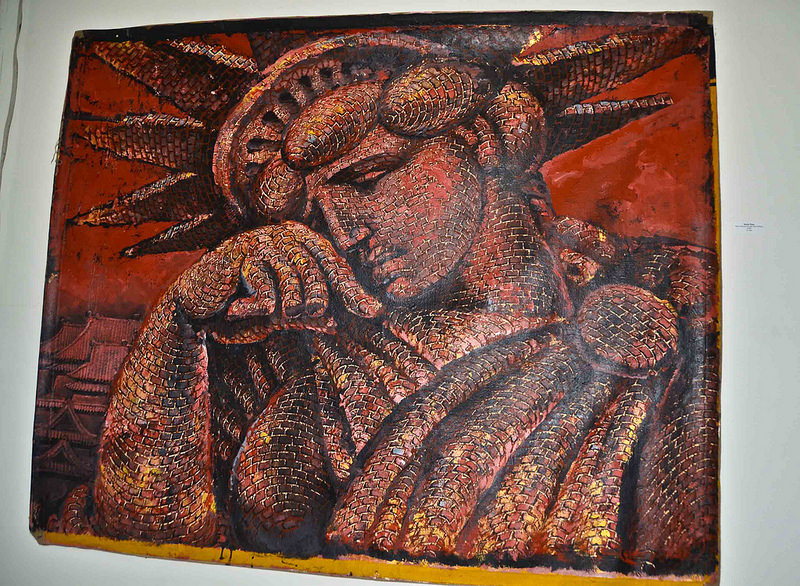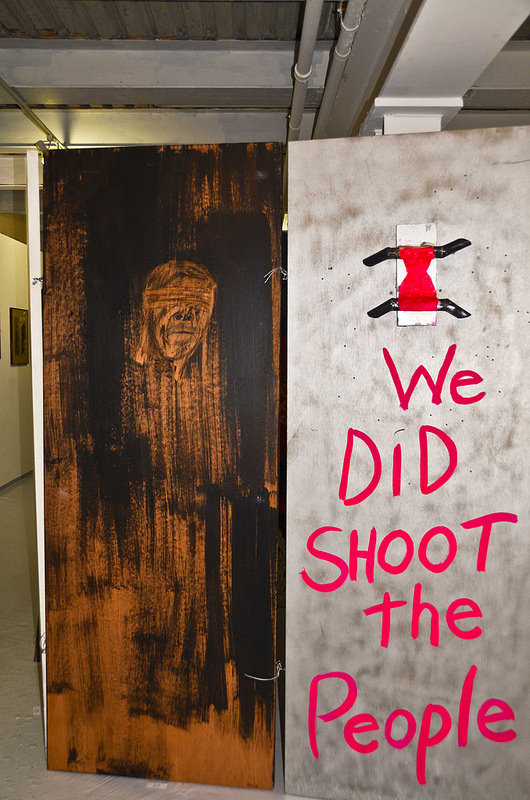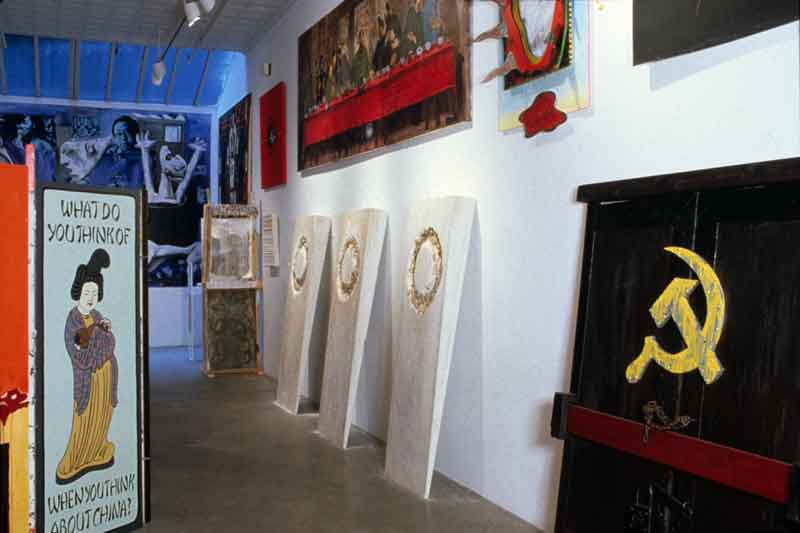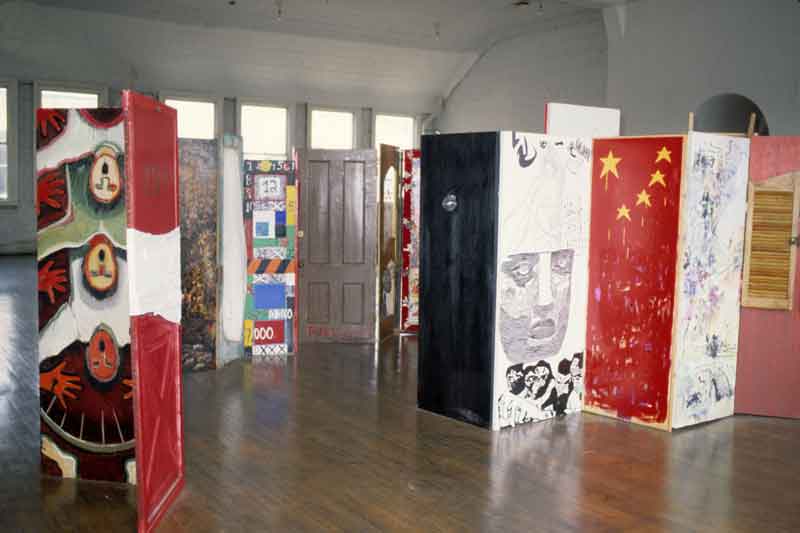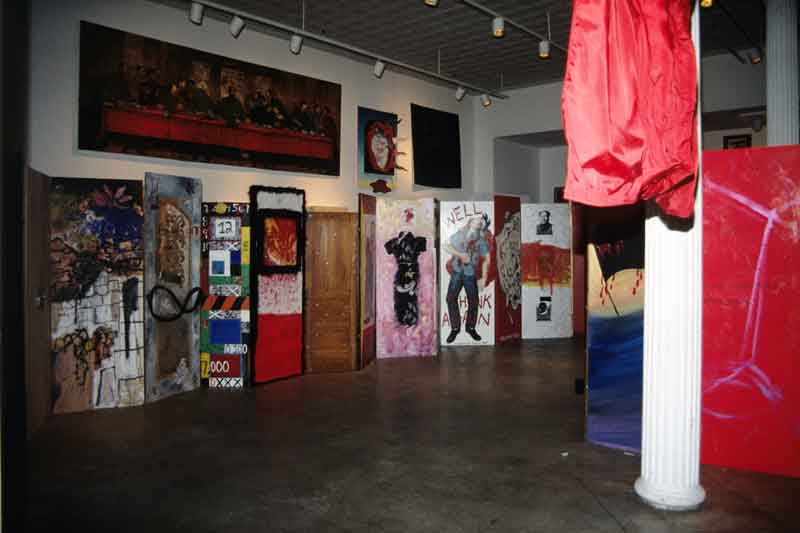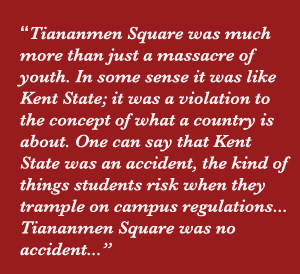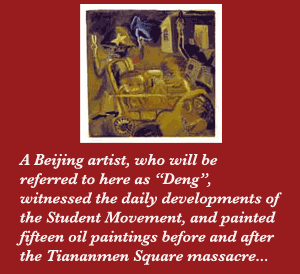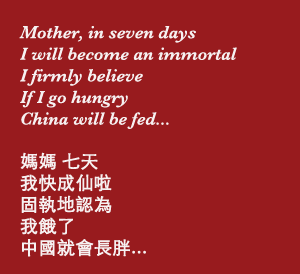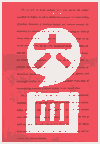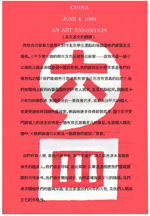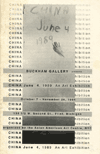

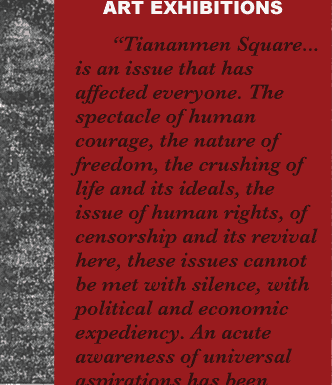
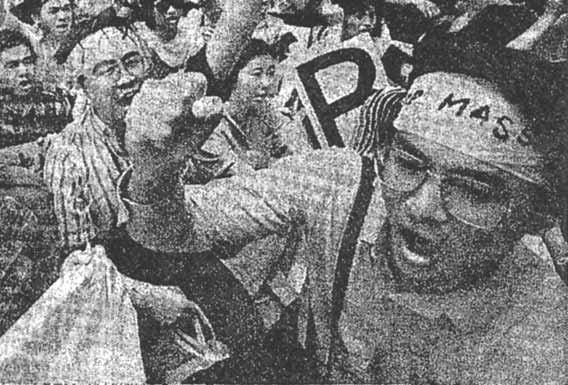
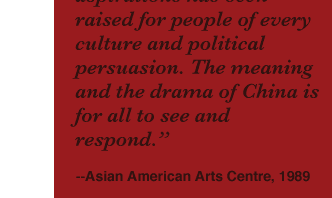
On June 5, 1989, in response to the massacre of the students in Tiananmen Square, the Asian American Arts Centre in NY initiated a year long exhibition that eventually brought over 300 artists to participate to draw attention to this historic tragedy. After the exhibit traveled to several sites over the next few years and the calls to have it and the informative materials that accompanied it died away, the exhibition and the art work that it encompassed lay dormant. Now, on the occasion of the Twentieth Anniversary of the Tiananmen Square Student Movement this exhibition is being revised with this online presence for all to see. Much has passed and China may no longer be the China that it was. For this exhibition, this is not the issue. Tiananmen Square, however, must not be forgotten. At the very least, as a few of the art works claim, forgetting must be resisted. So many artists came forward to give selflessly to this cause, creating innumerable memorable images. Together with the media event this historic moment became, and the photographic record that became metaphors in themselves, these art works manifest the public response, the outcry and passion that was felt around the world. If there is any message of these art works to be remembered, like the image of that sole resistor who stood before a line of tanks stopping them in their tracks, it is to stand up for what you believe. Remember Tiananmen Square...
June 9 - September 30, 1989: Initial exhibition shown at AAAC gallery
October 12 - November 12, 1989: Exhibition installed at Blum Helman Warehouse
November 20 - Jan 12, 1990: Exhibition continued at AAAC gallery
April 22 - June 17, 1990 at PS1 Museum
June 2, 1990: Tiananmen Square- A Memorial Performance of Music, Poetry and Dance
June 4 - June 24, 1990: Selection of "CHINA: June 4, 1989" artists in Hong Kong at the Hong Kong Art Centre
June 4, 1989 - May 10 to June 29, 1990: "Witnesses: CHINA" at AAAC
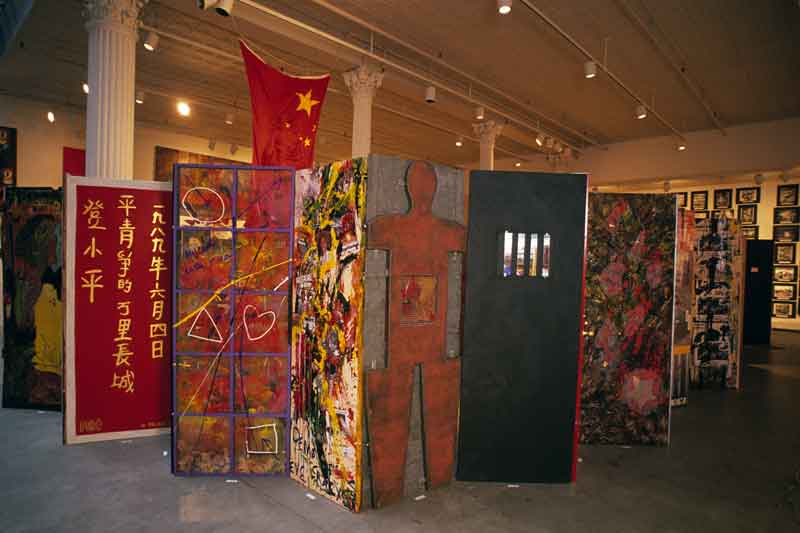
ARTWORKS FROM CHINA: JUNE 4, 1989 EXHIBITIONS
small works doors other
View full list of artists
Inquiries about this
exhibition—CHINA: June 4, 1989—its availability for touring or acquisition, can be sent to aaacinfo@artspiral.org.
For more information about this exhibition, see our exhibitions page.
Important Notice to Artists
Events Leading to June 4, 1989
| 1946-1949 | The end of World War II marks the renewal of Civil War between Nationalists and Communists for the leadership of China |
| 1949-1950 | Chinese Communist Party (CCP) controls the Chinese mainland; Chiang Kai-shek and Guomindang Army flee to Taiwan; Mao Zedong, proclaims the establishment of the People's Republic of China (PRC) October 1, 1949 |
| 1950-1953 | On June 25, 1950, North Korea crosse the 38th parallel and invades South Korea. PRC sides with Soviet-backed North Korea against what it sees as U.S. imperialism. President Truman orders Japan based U.S. troops to patrol the Taiwan Strait in an effort to prevent the PRC from invading Taiwan |
| 1953-1957 | CCP develops the "First Five Year Plan" using the Soviet Union as a model; Let a Hundred Flowers Bloom Campaign - Mao encourages the intellectuals to air their complaints regarding the CCP: Mao then joins with hardliners of the CCP in branding the intellectuals and sending them to labor camps or jail |
| 1958-1962 | Great Leap Forward - the campaign to put an end to private farming plots and to organize all of rural China into people's communes fails |
| 1966-1969 | Great Proletarian Cultural Revolution - a call for an attack on the "four old" elements in Chinese society; old customs, old habits, old culture, and old thinking; many injustices are inflicted upon the people by the Red Guards; a time of national chaos and destruction |
| 1972-1974 | President Nixon travels to China to meet with Mao, and later Henry Kissinger, U.S. Secreatary of State, travels to China to meet with Zhou Enlai; cautious relations are established between the U.S. and China |
| 1976 | January 9th Zhou Enlai, top official in CCP dies; Mao Zedong dies on September 9th |
| 1977-1980 | Deng Xiaopeng's role in the leadership is rehabilitated; he launches the "Beijing Spring" allowing open criticism of the Cultural Revolution; he argues for socialism with Chinese characteristics with the famous phrase, "Whether a cat is black or white makes no difference. As long as it catches mice, it is a good cat." |
| 1979-1984 | Flow of materials on the cultural developments of the West increases, initiating change among artists throughout China. Example of this is the "Star Star exhibition in Beijing". This development quickens in 1985 and acquires momentum. Widespread corruption within the party; many high-ranking veterans of the CCP resign; Hua Guofeng replaced by Zhao Ziyang as premier in 1980; Hu Yaobang appointed party chief in 1981; Deng consolidates his influence in the CCP |
| 1985-1987 | Farming communes are dismantled and divided into small private parcels; population control is enforced - only one child per family allowed; corruption spreads as economic opening to the West continues; General malaise continues to grow; many people, especially students express their dissatisfaction over China's shifting role |
| 1988 | Repression continues against those who speak of democracy while many benefit from the economic reforms - materialism abounds. Li Peng is named acting premier |
| 1989 | An anniversary year of special significance for China; 200th anniversary of the French Revolution, 70th anniversary of the May Fourth movement, 40th birthday of the People's Republic itself, 10th anniversary of the reinstitution of formal diplomatic relations with the United States. A decade of cultural openness to the West abruptly stops with the closure of a new major contemporary art exhibition in Beijing on February 5 1989 at the National Palace of Fine Arts |
| April 15, 1989 | Wu Yao Bang passed away. An enlightened leader, people expressed their mourning and discontent with spontaneous small demonstrations. This incident unlocked the long suppressed pro-democracy sentiments of people. The demonstrations grew. On April 19 more than 100,000 people held a sit-in at Tiananmen Square |
| April 22, 1989 | In spite of government plans made to cordon off the whole of Tiananmen Square, students are able to enter the square and mount their demonstrations and events before police have taken up their positions. In a sincere gesture, reminiscent of Qing practice, several students kneel on the steps of the Great Hall and beg Premier Li Peng to come out and talk to them. He declines |
| April 24, 1989 | Students begin a mass boycott of classes in an attempt to pressure government leaders into hearing their requests |
| April 26, 1989 | The official government newspaper, the People's Daily, labeled the student movement as a riot instigated and organized by a small number of wicked people. It called upon the whole nation to suppress the "riot". The infamous "4/26 editorial" was joined by the mobilization of the 38th Army |
| April 27, 1989 | The student movement developed into a people's movement. Students who marched into the Square numbered 200,000. Over a million civilians showed support on the roads. A federation of all student associations was formed |
| May 4, 1989 | The students are now joined by many of their teachers, scores of journalists, and by many citizens of Beijing. 100,000 march in Beijing, dwarfing the historic student demonstrations of the May 4 Movement in 1919. Demonstrations occur in other cities and overseas as well. Students begin a hunger strike |
| May 13, 1989 | Hunger strike grows to two thousand participants. Government officials agree to a dialogue with the student leaders on the 14th, just before Mikhael Gorbachev is scheduled to visit Beijing. On the 15th police order the clearing of the Square |
| May 17, 1989 | About two million Beijing citizens march onto the streets. The spectrum of demonstrators from all walks of life include a thousand soldiers of the People's Liberation Army. Demonstrations are reported in over twenty provinces |
| May 18, 1989 | Premier Li Peng agrees to meet with the students. Secretary-General Zhao Ziyang visits the hunger strikers and urges them to end their fast. |
| May 20, 1989 | Premier Li Peng and the president of China, Yang Shangkun, declare martial law and order units of the People's Liberation Army to return order to the city. Demonstrators build barricades around themselves and urge the troops not to enforce the martial law restrictions. Armed troops head toward Tiananmen Square but are blocked by people on the road and who sleep at night there preventing passage |
| May 22, 1989 | A hundred thousand soldiers surround Beijing. Twenty thousand students vow to stay on the Square. "...our blood may be shed, yet we cannot give up freedom and democracy. May our lives and blood call upon a beautiful future for our Republic" |
| End of May 1989 | Student leaders encourage their fellow students to end the hunger strike and return to their campuses but there are new recruits from other cities. A thirty foot statue of the student's version of liberty is built. Military action it is stated would not be used to suppress the students, but the government repeat their claim, labeling this pro-democracy movement a riot |
| June 4, 1989 | Late at night well-armed troops from the Twenty-seventh Army and other units loyal to Deng smash through the barricades in heavy tanks and armored personnel carriers and put an end to the students' brave movement |
Available daily to visitors to AAAC in June and July 2009: a video of the Student Leader Chai Ling making her statement on June 8 over visuals of the massacre (30min).
Also available is a video of American News Reports from Mid May to June 4th in NY including some on NY Chinatown (1.5 hrs).
OTHER JUNE 4 EVENTS AND RELATED LINKS:
Conference and photo exhibition: Commemorating the Unforgettable Laogai Research Foundation, Laogai Museum, National Endowment for Democracy June 4, 2009 9 AM-5PM, Rayburn Foyer, Rayburn House Office Building
Candlelight Vigil June 4, 2009 at 8PM: Consulate-General of the PRC 443 Shatto Place, Los Angeles, CA, and Portsmouth Square,San Francisco, CA
Khiang H. Hei Photo Exhibit: Christopher Henry Gallery, 127 Elizabeth Street, New York, NY, USA May 29-June 29, 2009
Human Rights in China
You can donate to keep the vital work of AAAC active!
Please give generously online on our
membership page or send your donations to:
Asian American Arts Centre, 111 Norfolk Street, New York, NY 10002
-----
© 2009 Asian American Arts Centre
Web design by Karen Li-Lun Hwang